STATUS
LEAKED — NO OFFICIAL RESPONSE
ORIGIN
4chan /g/ → Archive.org → GitHub mirrors
ALLEGED SOURCE
Former 4J Studios employee
003 LEGACY CONSOLE FINDINGS
Everything the community has uncovered from the Legacy Console Edition codebase — cut worlds, prototype features, and developer secrets hidden for 12 years. Code shown side-by-side: readable summaries on the left, actual verbatim source on the right.
The Trial World: Minecraft's Forgotten Prototype
Buried at Minecraft.Client/Common/Trial/TrialLevel.mcs sits an entire 512x512 world that was never released. It's a prototype "Trial Mode" — an early version of the Tutorial World that 4J scrapped partway through development.
Spawn Town
A small settlement with buildings, pathways, and a central area. Parts of it were later recycled into the final Tutorial World, but in different positions.
Castle & Lighthouse
A full castle structure and a lighthouse built as landmarks. Both were cut from the final tutorial. Aerial views show significant construction effort.
9 Debug Chests
Chests stuffed with test items scattered across the map. Standard QA practice — devs needed to quickly test inventory, crafting, and item interactions.
Floating Minecraft Logo
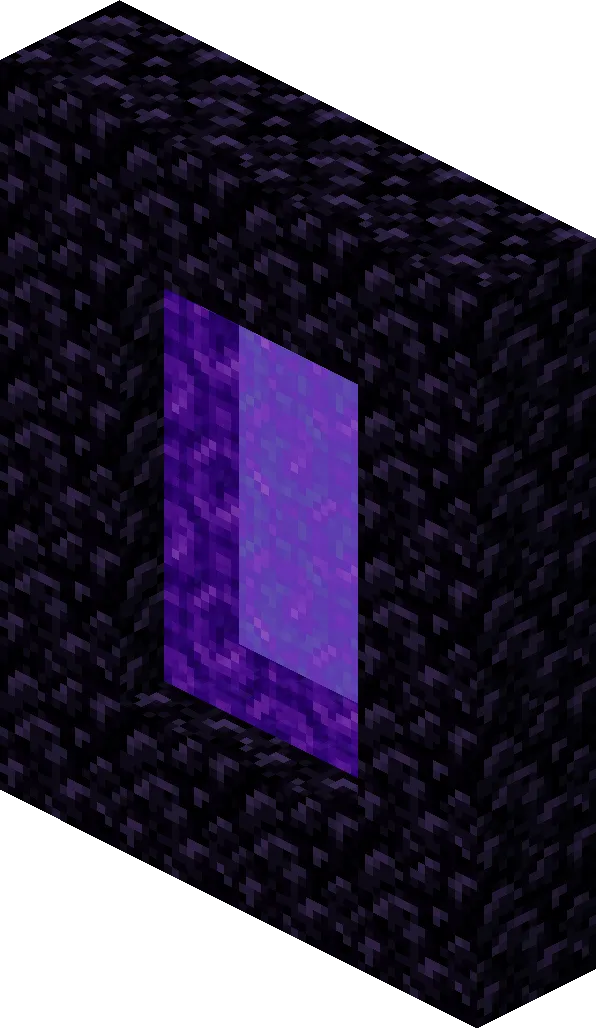
A giant Minecraft logo hovering above the town. In the TU3-4 tutorial world, levers on each side of the logo reveal a concealed hallway with a lit Nether portal inside.
// The trial world can't be opened normally.
// Header format is different from the final release:
//
// RELEASE (Late Proto):        EARLY PROTO:
// 0x00: Decompressed size      0x00: Padding
// 0x04: Padding                0x04: Compressed size
// 0x08: Compressed size        0x08: End of file
//
// Fix: Swap the header fields in a hex editor
// to decompress and load the world.
The Trial World also contains gibberish signs, half-finished lever-trapdoor puzzles, and a mountainside wall with pathways — all abandoned mid-construction. It's a snapshot of a feature being actively built when the team pivoted to the Tutorial World instead.
Skylands: The Floating Islands
Remnants of Notch's original "Sky Dimension" — a world type where islands floated above an infinite void. Partially implemented in Java Alpha, then abandoned. The console code still has the entire terrain generation logic intact — a compile-time flag away from working.
READABLE VERSION
// RandomLevelSource.h
// A single flag controls floating islands.
// Set to false — disabled but functional.
static const bool FLOATING_ISLANDS = false;

// RandomLevelSource.cpp
// When enabled, two Perlin noise generators
// create the island terrain shape
if (FLOATING_ISLANDS) {
    floatingIslandScale = new PerlinNoise(random, 10);
    floatingIslandNoise = new PerlinNoise(random, 16);
}

// SkyIslandDimension.cpp
// An orphaned dimension class — no .h file
// exists for it. Uses Biome::sky (ID 9).
// hasGround() returns false — infinite void.
ACTUAL SOURCE
void SkyIslandDimension::init()
{
    biomeSource = new FixedBiomeSource(
        Biome::sky, 0.5f, 0);
    id = 1;
}

ChunkSource *SkyIslandDimension::
    createRandomLevelSource() const
{
    return new SkyIslandRandomLevelSource(
        level, level->getSeed());
}

bool SkyIslandDimension::hasGround()
{
    return false;
}

float SkyIslandDimension::getCloudHeight()
{
    return 8;
}
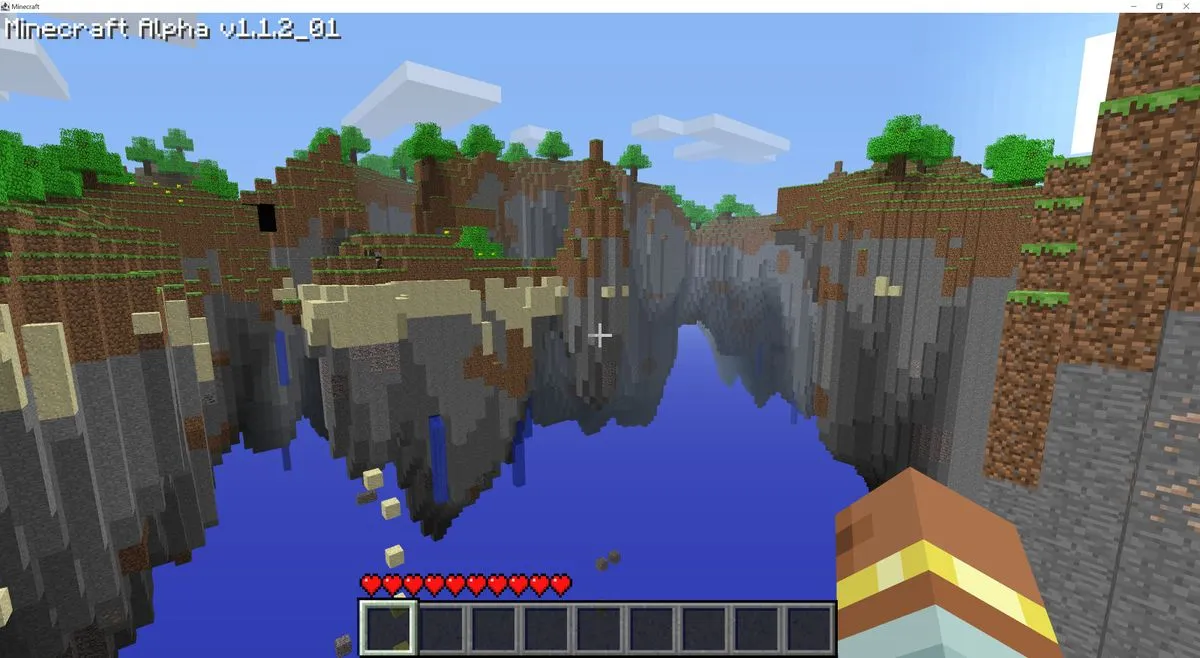 Restored Skylands in Alpha v1.1.2_01 — floating islands over ocean, trees and waterfalls intact. Screenshot via MrLordSith.
Modder MrLordSith restored the floating islands and got them generating — islands hovering over oceans with trees and waterfalls. The FLOATING_ISLANDS constant in RandomLevelSource.h is all that separates this from working. A complete world type, hidden behind a boolean for 12 years.
Waterfall Foam: The Dead Code Loop
Someone at 4J Studios tried to add foam/bubble particle effects where water fell from height. The code is still there — but it's dead code. The loop condition is i < 0, meaning it never executes. Developer "4J-PB" left a comment confirming it.
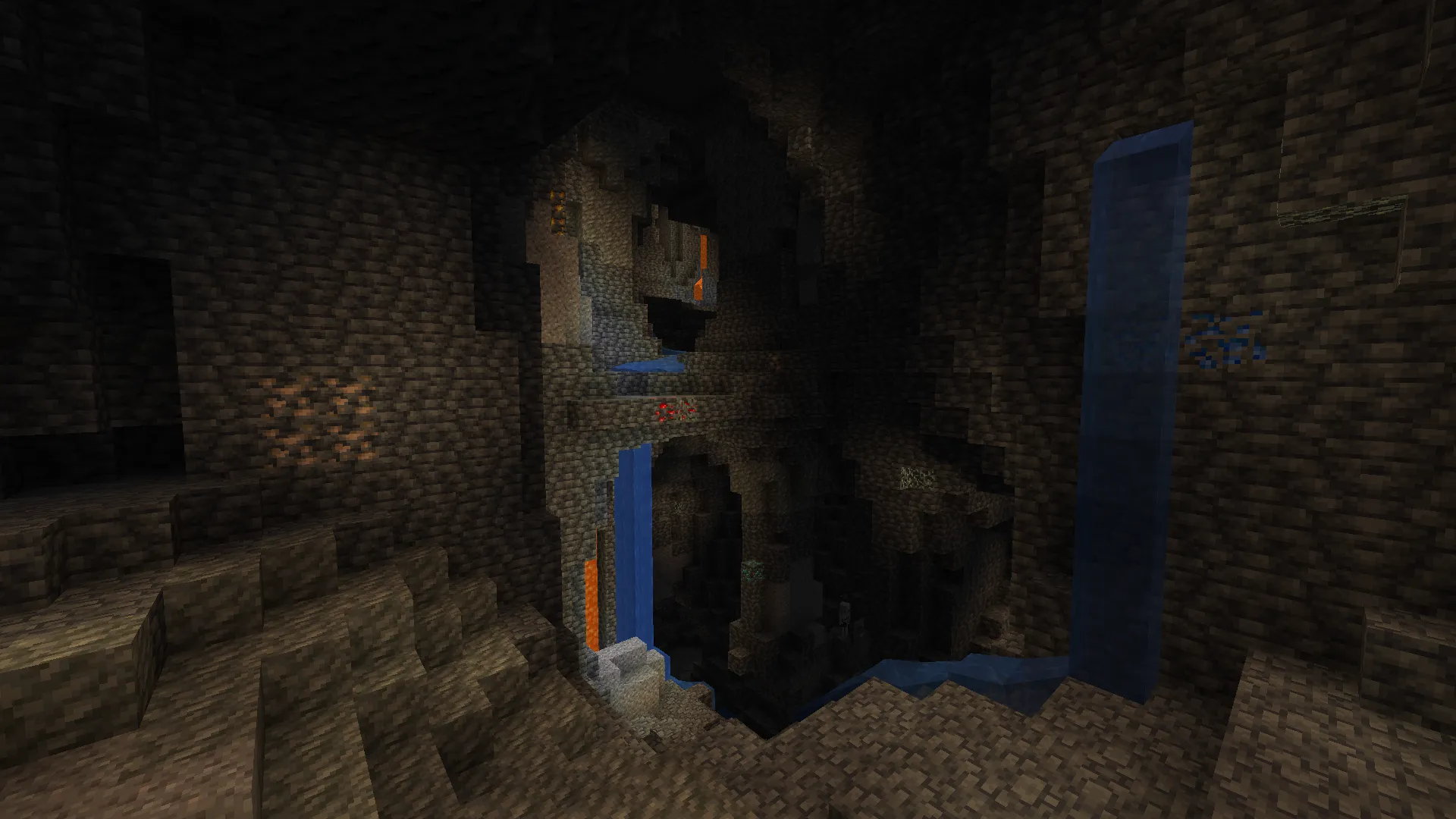
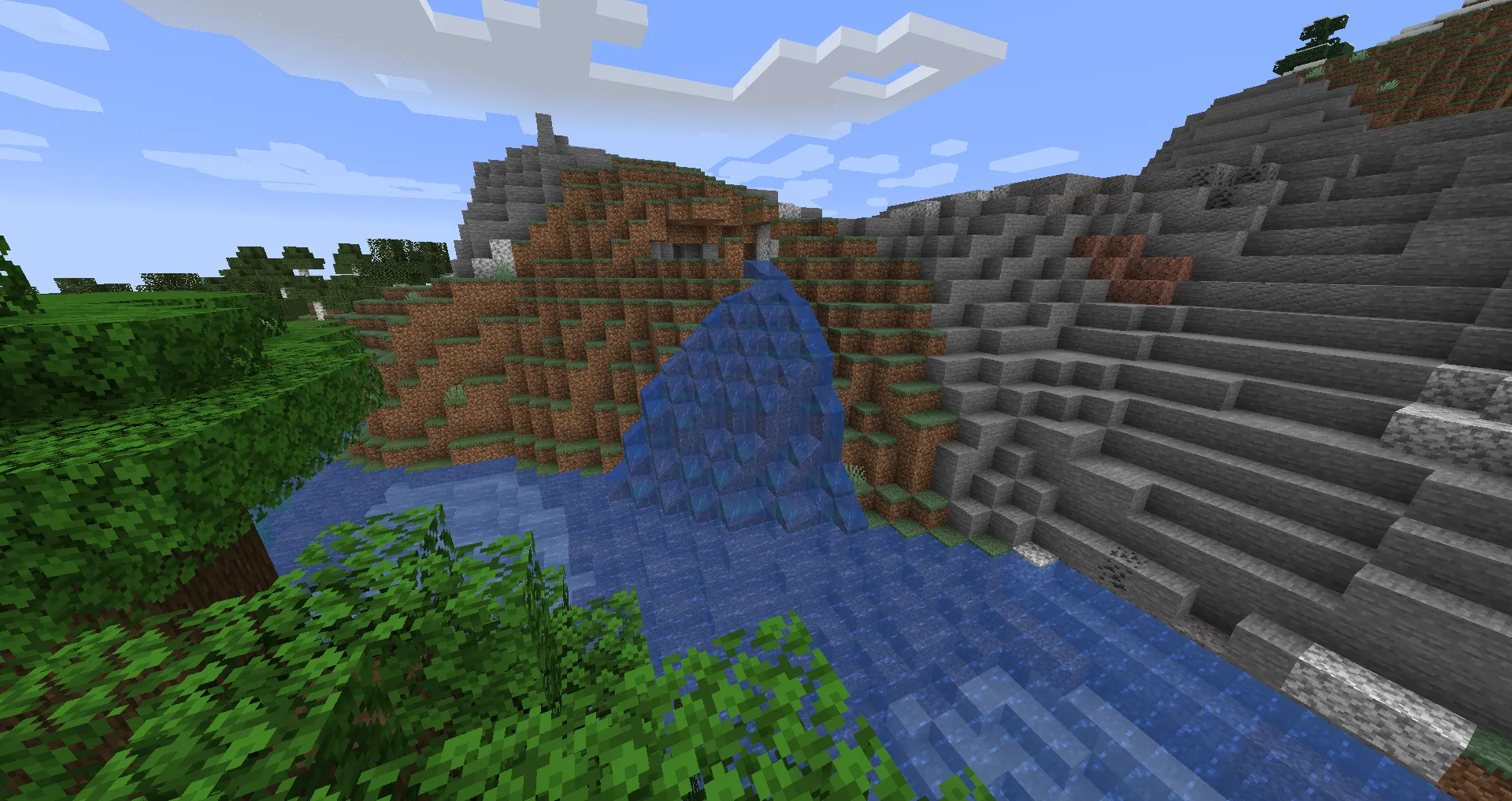 A standard Minecraft waterfall. The foam code would have spawned splash particles where the water hit the ground — but the loop was disabled and never re-enabled.
READABLE VERSION
// Inside animateTick() — the foam attempt.
// The loop says i < 0, so it NEVER runs.
// "4J-PB" is a developer at 4J Studios.

// 4J-PB - this loop won't run!
for (int i = 0; i < 0; i++)
{
    // This was an attempt to add foam to
    // the bottoms of waterfalls. It
    // didn't went ok.

    // Picks a random direction, checks for
    // air above a solid/liquid block, then
    // spawns a splash particle.
    level->addParticle(
        eParticleType_splash,
        xx, yy, zz, xd, 0, zd);
}
ACTUAL SOURCE
// 4J-PB - this loop won't run!
for (int i = 0; i < 0; i++)
{   // This was an attempt to add foam to
    // the bottoms of waterfalls. It
    // didn't went ok.
    int dir = random->nextInt(4);
    int xt = x;
    int zt = z;
    if (dir == 0) xt--;
    if (dir == 1) xt++;
    if (dir == 2) zt--;
    if (dir == 3) zt++;
    if (level->getMaterial(xt, y, zt)
        == Material::air &&
        (level->getMaterial(xt, y-1, zt)
            ->blocksMotion() ||
         level->getMaterial(xt, y-1, zt)
            ->isLiquid()))
    {
        float r = 1 / 16.0f;
        double xx = x + random->nextFloat();
        double yy = y + random->nextFloat();
        double zz = z + random->nextFloat();
        // ... direction offsets ...
        level->addParticle(
            eParticleType_splash,
            xx, yy, zz, xd, 0, zd);
    }
}
"It didn't went ok." — grammatical error and all, that's the real comment. The developer disabled it by making the loop condition impossible (i < 0) rather than deleting the code. A common pattern when you want to keep something around "just in case" but never come back to it.
Village Generation: From Java Generics to C++ Enums
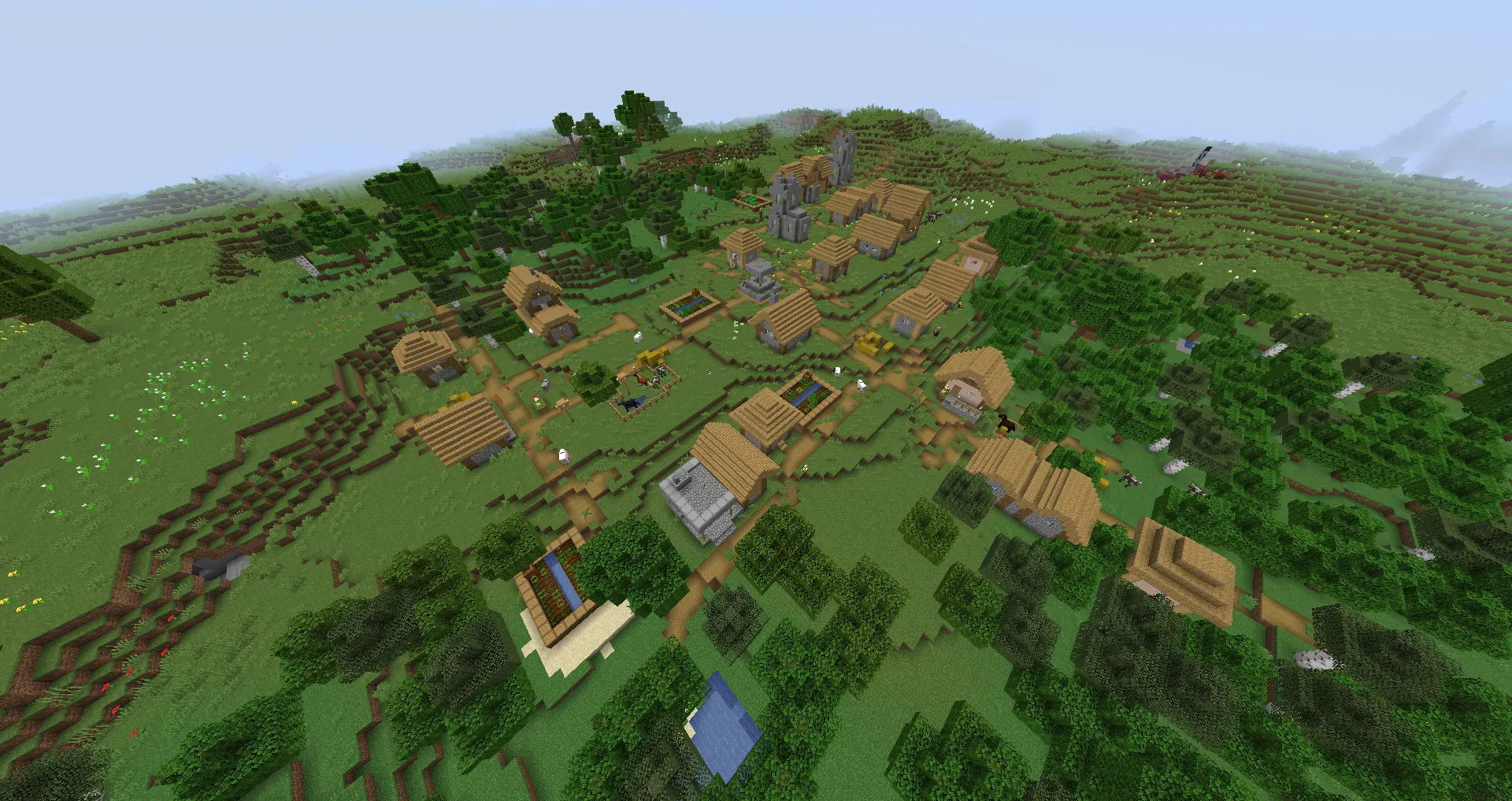 The final Plains village layout. The leaked code shows 4J's C++ port of the Java village system — replacing Java generics with enums and factory functions.
The village system is one of the clearest examples of 4J's Java-to-C++ porting work. Java Minecraft used Class<? extends VillagePiece> for building types — a pattern that doesn't exist in C++. 4J replaced it with an enum and factory registration system across VillagePieces.cpp (2,025 lines).
READABLE VERSION
// Java used Class<? extends VillagePiece>
// C++ has no equivalent, so 4J made an enum
// for every building type in a village.

enum EPieceClass {
    EPieceClass_SimpleHouse,
    EPieceClass_SmallTemple,
    EPieceClass_BookHouse,
    EPieceClass_SmallHut,
    EPieceClass_PigHouse,
    EPieceClass_DoubleFarmland,
    EPieceClass_Farmland,
    EPieceClass_Smithy,
    EPieceClass_TwoRoomHouse
};

// Each piece type gets a 4-char ID
// and a factory Create function
// registered with StructureFeatureIO.
ACTUAL SOURCE
// 4J - added to replace use of
// Class<? extends VillagePiece>
// within this class
enum EPieceClass
{
    EPieceClass_SimpleHouse,
    EPieceClass_SmallTemple,
    EPieceClass_BookHouse,
    EPieceClass_SmallHut,
    EPieceClass_PigHouse,
    EPieceClass_DoubleFarmland,
    EPieceClass_Farmland,
    EPieceClass_Smithy,
    EPieceClass_TwoRoomHouse
};

// VillagePieces.cpp — loadStatic()
StructureFeatureIO::setPieceId(
    eStructurePiece_Well,
    Well::Create, L"ViW");
StructureFeatureIO::setPieceId(
    eStructurePiece_StraightRoad,
    StraightRoad::Create, L"ViSR");
StructureFeatureIO::setPieceId(
    eStructurePiece_SimpleHouse,
    SimpleHouse::Create, L"ViSH");
StructureFeatureIO::setPieceId(
    eStructurePiece_Smithy,
    Smithy::Create, L"ViS");
4J also reduced village spacing for small worlds — townSpacing = 16; // 4J change 32; — and added bounds checks to prevent villages spawning over world edges. The comment "4J-PB - Adding a bounds check to ensure a village isn't over the edge of our world" shows the kind of console-specific fixes the original Java code never needed.
Minecraft Windows Edition: The Lost Port
SWF-format UI files reference a "Minecraft Windows Edition" — a separate PC version 4J Studios was building. This wasn't Java Edition. It was a direct console-to-PC port using the C++ Legacy Console codebase. Microsoft killed it in favor of the Bedrock-based Windows 10 Edition.
The community compiled the Windows64 debug build and got it running on PC. It needs a controller and has no audio — but it works, including multiplayer. Modders quickly added keyboard+mouse support.
256MB: Fitting Minecraft in a PS3
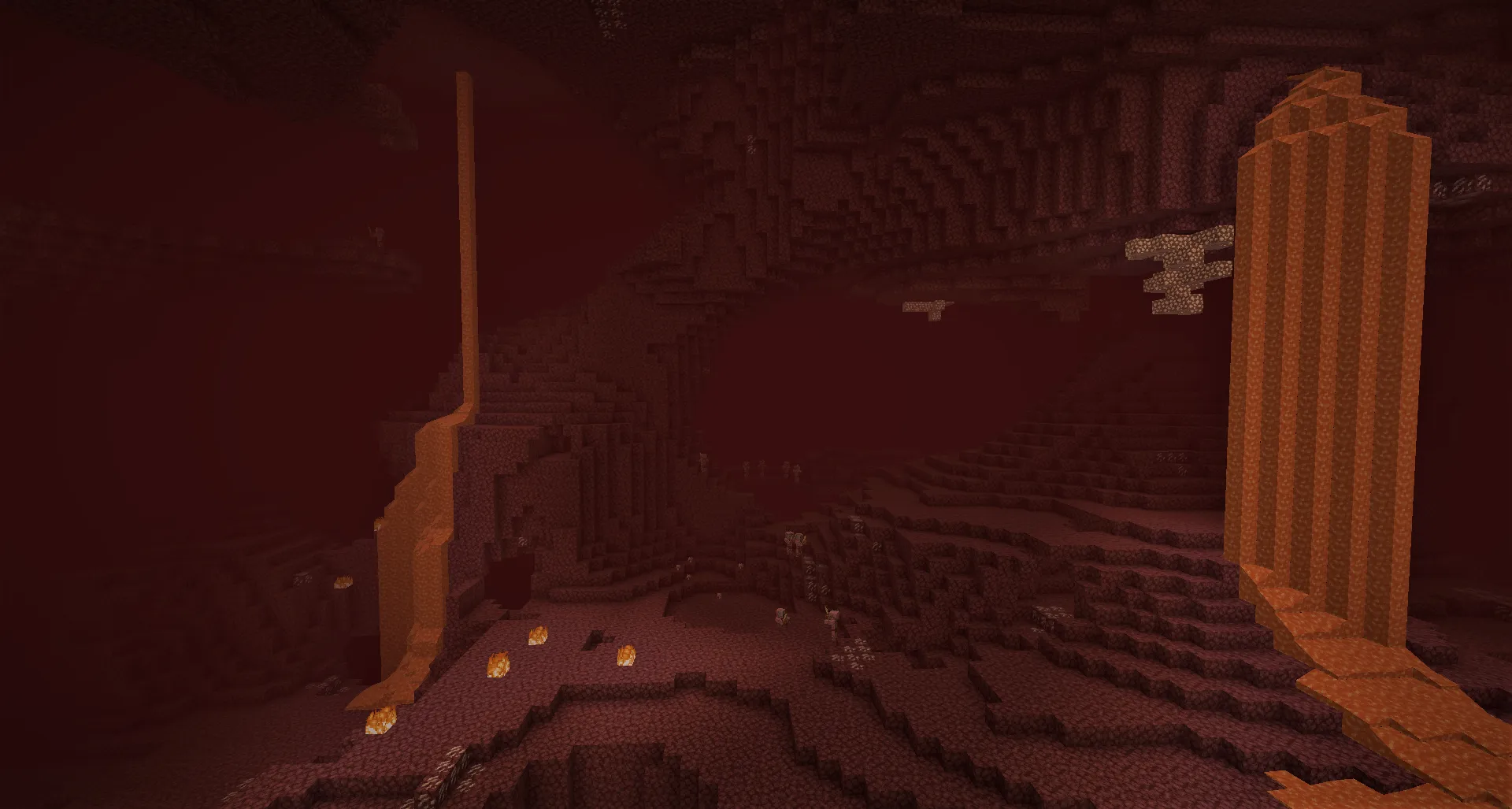 The Nether — one of the most demanding environments to render. On PS3, this had to fit within a 180MB working memory budget after the OS took its cut.
The PS3 had 256MB of system RAM. Running a procedural world in that space required custom compression and parallel processing on the Cell SPU. The code reveals exactly how — CompressedTileStorage for block data, SparseLightStorage for lighting, and SPU jobs for terrain generation.
READABLE VERSION
// Block data is split into lower (Y 0-127)
// and upper (Y 128-255) halves, each with
// custom compressed storage to fit in RAM.

CompressedTileStorage *lowerBlocks;
CompressedTileStorage *upperBlocks;
SparseLightStorage *lowerSkyLight;
SparseLightStorage *upperSkyLight;

// PS3 uses Cell SPUs for parallel terrain gen.
// 5 Perlin noise jobs run simultaneously on
// SPU cores. Other platforms do it sequentially.

#if defined __PS3__
    // submit 5 noise jobs to SPUs
    port.waitForCompletion();
#else
    // sequential noise calculation
#endif
ACTUAL SOURCE
// 4J - actual storage for blocks is now
// private with public methods to access it
private:
    CompressedTileStorage *lowerBlocks; // 0-127
    CompressedTileStorage *upperBlocks; // 128-255

    SparseDataStorage *lowerData; // 0-127
    SparseDataStorage *upperData; // 128-255

    SparseLightStorage *lowerSkyLight;
    SparseLightStorage *upperSkyLight;
    SparseLightStorage *lowerBlockLight;
    SparseLightStorage *upperBlockLight;

// RandomLevelSource.cpp
#if defined __PS3__ && !defined DISABLE_SPU_CODE
    C4JSpursJobQueue::Port port(
        "C4JSpursJob_PerlinNoise");
    C4JSpursJob_PerlinNoise perlinJob1(
        &g_scaleNoise_SPU);
    // ...submits 5 noise jobs to SPUs
    port.waitForCompletion();
#else
    sr = scaleNoise->getRegion(sr, x, z,
        xSize, zSize, 1.121, 1.121, 0.5);
#endif
The CompressedTileStorage header contains a detailed comment explaining the compression algorithm: data is split into 512 blocks of 4x4x4 tiles, using variable bit widths (1, 2, 4, or 8 bits per tile). Physical memory allocation bypasses the general heap manager entirely — XPhysicalAlloc(blocksSize, MAXULONG_PTR, 4096, PAGE_READWRITE). This is what "bare metal" C++ looks like.
Herobrine: He's in the Skins (Not the Code)
The community myth that Mojang "removes Herobrine" in every changelog was always a running joke. So what does the leak actually show? Zero Herobrine game logic. No entity. No AI. No reserved ID. Nothing.
The only Herobrine references in the entire codebase are DLC skin pack entries — binary .pck files loaded through DLCSkinFile.cpp. He's a purchasable cosmetic in Skin Pack 1, alongside variants like "Zombie Herobrine" (Skin Pack 3), "Party Herobrine" (1st Birthday Pack), and "Xmas Herobrine" (Festive Mash-up).
// Herobrine exists only as skin data in binary .pck files:
Minecraft.Client/DurangoMedia/DLC/Skin Pack 1/Skins1.pck
Minecraft.Client/PS3Media/DLC/Skin Pack 1/Skins1_Sony.pck
Minecraft.Client/PSVitaMedia/DLC/Skin Pack 1/Skins1_Sony.pck

// Loaded through:
Minecraft.Client/Common/DLC/DLCSkinFile.cpp
Minecraft.Client/Common/DLC/DLCManager.cpp

// Skin parameters stored in .pck binary data:
// e_DLCParamType_DisplayName, e_DLCParamType_ThemeName,
// e_DLCParamType_Free

// No entity code. No AI. No reserved ID. Just skins.
Here's the real easter egg: later Legacy Console Edition updates quietly removed the Herobrine skin from Skin Pack 1 — without mentioning it in the changelog. Making "Removed Herobrine" accidentally true for once. The joke wrote itself.
Developer Comments: Inside 4J's Culture
One of the most revealing aspects of the leak isn't a feature — it's the developer comments. 4J developers signed their work with prefixes like 4J-PB, 4J Stu, 4J JEV, 4J-TomK, and others. Their comments tell the story of porting a Java game to C++ on constrained hardware.
READABLE VERSION
// Developer signatures found across the codebase:
// "4J-PB"    — waterfall foam, village bounds
// "4J Stu"   — input system, chunk storage
// "4J JEV"   — various fixes
// "4J-TomK"  — Vita touch controls
// "MGH", "AP"— additional devs
//
// A small studio in Dundee, Scotland,
// signing their work in a codebase they
// maintained across 6 platforms for 7 years.
ACTUAL SOURCE
// RandomLevelSource.cpp
BiomeArray biomes;
// 4J created locally here for thread
// safety, java has this as a class member

// Input.cpp
// 4J Stu - Assume that we only need one
// input class, even though the java has
// subclasses for keyboard/controller

// LiquidTile.cpp
// 4J - change brought forward from 1.8.2
// 4J - note that this code seems to
// basically be a hack to fix a problem
// where post-processed things like lakes
// aren't getting lit properly

// RandomLevelSource.cpp
// this just doesn't seem right - this
// isn't a new fault in the 360 version,
// have checked that java does the same.
These aren't polished postmortem quotes. They're real-time developer notes — confusion, workarounds, and the occasional resigned acceptance that Java's bugs were now their bugs too. A small studio's entire working culture, preserved in comments nobody expected anyone outside 4J to ever read.
PS Vita: Touch Controls and Ad-Hoc Multiplayer
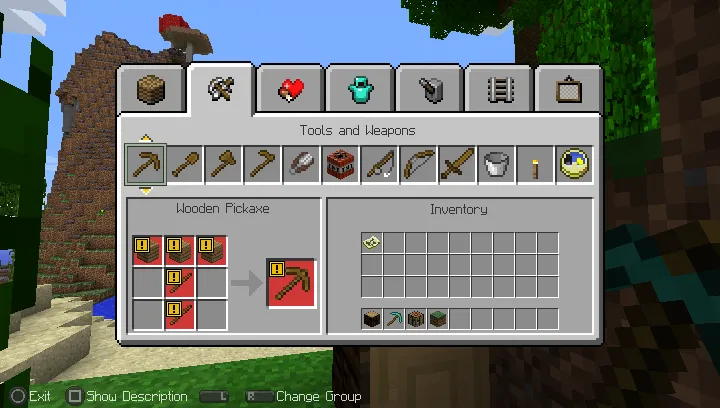 Minecraft PS Vita Edition crafting UI. The leaked code shows 4J-TomK's touch control system and dedicated .swf UI files for every Vita screen.
The Vita port shipped in 2014, but this leak shows the full touch control system, Vita-specific UI files, and even ad-hoc wireless multiplayer code. Developer "4J-TomK" handled the touch integration.
READABLE VERSION
// 4J-TomK built the Vita touch system.
// Touch controls register with a "touch box"
// list for each UI layer (HUD, menus, etc).
// Vita also has dedicated .swf files:
//   HUDVita.swf, ControlsVita.swf,
//   CraftingMenuVita.swf, etc.
//
// Plus ad-hoc wireless multiplayer at:
//   PSVita/Network/
//   SQRNetworkManager_AdHoc_Vita.cpp
ACTUAL SOURCE
void UIControl_Touch::init(int iId)
{
    m_id = iId;

    // 4J-TomK - add this touch control
    // to the vita touch box list
    switch(m_parentScene
        ->GetParentLayer()->m_iLayer)
    {
    case eUILayer_Error:
    case eUILayer_Fullscreen:
    case eUILayer_Scene:
    case eUILayer_HUD:
        ui.TouchBoxAdd(
            this, m_parentScene);
        break;
    }
}
The Vita port had dedicated versions of every UI screen as separate .swf files, ad-hoc wireless multiplayer networking, and a touch control layer that registered per-UI-layer. The shipped version scaled back touch features — but the code shows a more ambitious original vision.
Java Edition DNA in C++ Code
4J ported Minecraft from Java to C++ for consoles. The Java heritage is everywhere — from the header file naming convention that mirrors Java's package structure to explicit porting comments explaining every architectural decision they had to rethink.
READABLE VERSION
// C++ headers are named after Java packages:
net.minecraft.world.level.h
net.minecraft.world.entity.h
net.minecraft.world.level.levelgen.h
net.minecraft.world.level.biome.h
net.minecraft.world.entity.npc.h

// Java's class hierarchy was flattened.
// Class<? extends T> became enums.
// HashMap became flat arrays + spatial hash.
// Garbage collection became manual memory.
// Every abstraction had to be rethought.
ACTUAL SOURCE
// Input.cpp
// 4J Stu - Assume that we only need one
// input class, even though the java has
// subclasses for keyboard/controller
// This function is based on the
// ControllerInput class in the Java, and
// will probably need changed

// VillagePieces.h
EPieceClass pieceClass;
// 4J - EPieceClass was
// Class<? extends VillagePiece>

// LevelChunk.h
byteArray biomes; // 4J Stu - Made public
short terrainPopulated;
// 4J - changed from bool to bitfield
// within short

// RandomLevelSource.cpp
doubleArray buffer;
// 4J - used to be declared with class
// level scope but tidying up for thread
// safety reasons
"Will probably need changed" — written in Scottish English, from a studio in Dundee. Every Java convenience became a C++ engineering problem. HashMap became spatial hashing. ArrayList became fixed arrays. Class generics became enums. And through it all, a small team documented every decision in comments nobody expected to be read.
005 BY THE NUMBERS
7
Platform Targets
PS3, PS4, Xbox 360, Xbox One, Wii U, PS Vita, Win64
3
Development Backups
Feb 2013, Oct 2014, Dec 2014
831
.cpp Files
In Minecraft.World/ alone
12
Years Hidden
Written 2013-2014, leaked Feb 2026
2
Complete Codebases
Legacy Console Edition + Pocket Edition
9+
Cut Features Found
Skylands, Trial World, Foam, Villages, & more
0
Official Responses
Microsoft and Mojang have said nothing
1
Working PC Build
Win64 compiles and runs with multiplayer